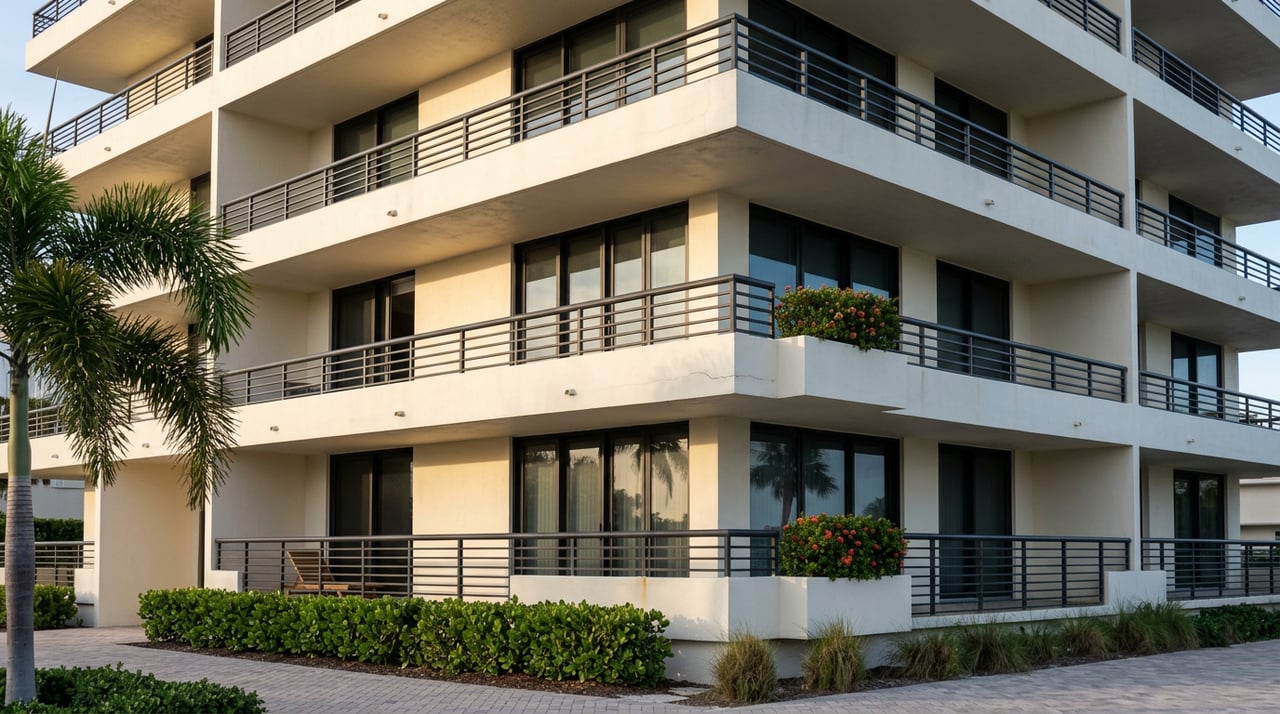
Two Park Shore towers finished their state-mandated structural reviews this year. Both have a completed Structural Integrity Reserve Study on file. Both technically comply with Florida law. As of this month, only one of them can still close as a conventional mortgage.
That is not a hypothetical. It is the mechanic sitting underneath most of the Park Shore condo listings you are looking at right now, and it rarely shows up in the version of this story that gets told to buyers. The story usually stops at "the building passed inspection." For a cash buyer, that may be enough. For anyone financing a purchase, it is only half the test.
What the state actually required, and when it was due
Florida rewrote condominium safety law twice after the 2021 Champlain Towers South collapse, first through SB 4-D and its 2023 companion SB 154, then again through HB 913 in 2025. Strip the legislative language down and two obligations apply to any residential condo or co-op building three habitable stories or taller: a milestone structural inspection, and a Structural Integrity Reserve Study, or SIRS, that plans and funds the major components of the building.
The milestone timeline depends on age and location. Buildings within three miles of a coastline, which describes essentially all of Park Shore, trigger their first Phase 1 inspection at 25 years rather than 30. The SIRS deadline was harder and already came due. Existing unit-owner-controlled associations were required to complete their SIRS by December 31, 2025, a date that is now more than seven months behind us. If a board also owed a milestone inspection by the end of 2026, it was allowed to fold the two studies together, but under no circumstance could the SIRS itself slide past December 31, 2026.
The financial piece is where the law actually bites. For any association budget adopted on or after December 31, 2024, the board can no longer vote to waive or underfund reserves for the components the SIRS identifies. The catch-all threshold for what counts as a reserve-worthy item rose from the old $10,000 figure to $25,000 under HB 913, adjusted annually. The Florida Department of Business and Professional Regulation set the 2026 figure at $25,675. Anything above that, on a named list that runs from roofs and load-bearing structure to waterproofing, fire protection, plumbing, electrical, and exterior windows and doors, has to be reserved for at whatever level the study recommends.
None of that is news to anyone who has already skimmed a Florida condo-safety explainer this year. Here is the part most of those explainers leave out.
The gap between legal and bankable
State law sets a floor. It does not require a board to fund at the highest tier the study allows, only to stop waiving reserves entirely. A board can adopt a legally compliant, lower funding schedule and still be sitting inside the letter of Florida law.
Fannie Mae is closing that gap from the other direction. As of August 3, 2026, Fannie Mae no longer accepts what is known as Baseline Funding, one of the state-approved minimum reserve methods, as sufficient for loans it will purchase. A building's adopted budget now needs to reflect the highest recommended funding plan in its own SIRS. A board that shows a "fully funded" plan on paper but actually approved a lower, still-legal tier puts a buyer's conventional loan at risk of rejection, even though the building has done nothing wrong under Florida statute.
A building can be perfectly legal and still be unbankable. Those used to be the same question. As of August 3 this year, they are not.
That distinction is easy to miss because both outcomes get described with the same word: compliant.
| Florida state law | Fannie Mae financing | |
|---|---|---|
| Standard | SIRS must exist and reserves may not be waived for post-2024 budgets | Budget must match the highest recommended tier in the SIRS, not merely a legal one |
| Deadline already in effect | SIRS completion required by December 31, 2025 | Baseline Funding no longer accepted as of August 3, 2026 |
| What "passing" looks like | A completed SIRS report with some funding toward every line item | A board resolution adopting the top funding tier, on the record |
| Where buyers get caught | Assuming a finished SIRS equals a healthy building | Discovering at underwriting that the board chose a lower legal path |
There is a second wave coming behind this one. Under Fannie Mae's separate 15 percent rule, effective January 4, 2027, any association without a professional reserve study completed in the last three years will see its required minimum reserve contribution jump from 10 percent to 15 percent of the total operating budget. The direction of travel is consistent. The distance between what Tallahassee requires and what a lender will actually finance is not closing. It is widening.
Why this lands harder in Park Shore than in newer neighborhoods
The Park Shore Association describes the neighborhood as home to more than 600 single-family lots and roughly 3,590 condominium units spread across 25 high-rise buildings, along with several mid-rise properties. Much of that gulf-front and bay-front stock dates to the 1960s, which means these towers were not merely eligible for the 25-year coastal milestone trigger years ago. Many have already cycled through more than one required inspection, and every one of them is now inside the reserve-funding rules regardless of when they were last reviewed.
That is not automatically bad news. One Park Shore building, Vistas at Park Shore, completed both its milestone inspection and its SIRS this cycle without needing to levy a special assessment on owners, a result its own compliance summary attributes to disciplined reserve funding and consistent building maintenance over time. That is the outcome a well-run board produces. It is also exactly the kind of building where a buyer still needs to ask the next question rather than stop at "no assessment was needed." A board can avoid a special assessment by choosing a funding tier that satisfies Florida law without satisfying Fannie Mae. Confirm which one you are looking at before you assume the two are the same thing.
What to actually request before you write an offer
- Ask for both documents, not a summary. Request the inspector's milestone summary, if the building has reached its trigger age, and the complete SIRS report, not a one-line compliance certificate.
- Ask which funding tier the board adopted, specifically. A completed SIRS satisfies the state. It does not tell you whether the board chose the highest recommended tier or a lower legal one. Since August 3, 2026, that choice determines whether your loan can close.
- Pull two years of budgets and actual financials. Compare what the association is contributing against what the SIRS says it should be contributing. A gap between the two is the clearest early signal of a future assessment.
- Ask about special assessment history going back five years, and anything approved but not yet billed. Pending is more important than past.
- Start your clock the moment documents arrive. Florida law gives buyers a seven-business-day window to cancel a contract without penalty once the association's governing documents, including inspection reports, are actually delivered. That window starts on receipt, not on the contract date. Read everything the first week, not the last.
What the current market suggests about timing
Public market trackers in February 2026 counted roughly 300 Park Shore properties on the market, a median list price near $2.1 million, and homes selling in around 87 days at about 94 percent of list price. That is a market with room to negotiate, not one where buyers need to waive due diligence to compete.
The financing detail matters more here than in most neighborhoods because of how Park Shore condos actually get bought. Brokerage reporting from early 2025 put cash purchases at roughly 71 percent of Naples-area condo sales, compared to about 57 percent for single-family homes. A large share of Park Shore's condo buyers never touch a Fannie Mae underwriting file at all. For the smaller group who does finance, the compliance gap described above is not a footnote. It can be the difference between a closing and a collapsed contract, discovered weeks in rather than at the offer stage where it is cheapest to catch.
FAQ
Does a completed SIRS mean a Park Shore condo will qualify for a conventional loan? Not automatically. A completed SIRS satisfies Florida law. As of August 3, 2026, Fannie Mae also requires the association's adopted budget to reflect the highest recommended funding tier from that same study. A building can check the state box and still fail the lender's.
What if a building still hasn't completed its SIRS? The statewide deadline for existing unit-owner-controlled associations was December 31, 2025, so any Park Shore building still without a completed study at this point is already behind. Ask directly where the association stands. If a milestone inspection is also due by the end of 2026, the two studies can be completed together, but under no circumstance can the SIRS itself land after December 31, 2026.
Does any of this apply to Park Shore's single-family homes? No. The milestone and SIRS rules apply to condominium and cooperative buildings three habitable stories or taller. Single-family buyers in Park Shore still have their own due diligence, centered on flood zone confirmation and waterfront maintenance costs, but not this particular compliance layer.
If you are weighing a specific Park Shore building and want a straight read on where its inspection and reserve paperwork actually stands, The Peter T. Rose Team can walk through the documents with you before you write an offer, not after.